Heat recovery unit helps to improve HVAC systems and energy savings
Heat recovery units for air conditioning are devices specifically designed to improve the efficiency of heating, ventilation and air conditioning (HVAC) systems by recovering and recycling heat from incoming and outgoing air flows.
This equipment is installed in the ventilation circuit of a building and its main purpose is to recover energy from the air used to air-condition an interior space by transferring, thanks to an exchanger, the temperature of the incoming and outgoing air, without the flow of these airs mixing.
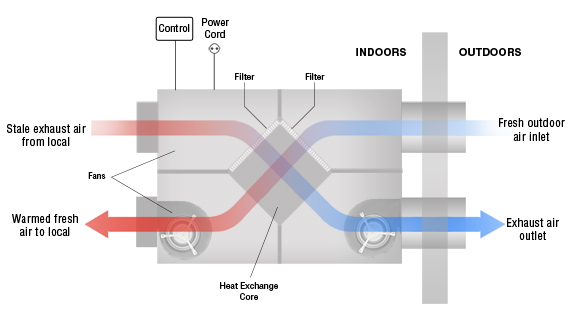
These systems are particularly useful in residential, commercial and industrial buildings, as they help to reduce energy consumption and heating and cooling costs.
In winter, the cold air is heated and in summer, the incoming air is cooled. They can be supplemented with filters to improve indoor air quality and are also a system that improves energy efficiency, which translates into greater energy and economic savings.
Classification of heat recovery units
There are two main types of heat recovery units used in air conditioning:
- Cross-flow heat recovery units: these devices allow heat transfer between two air flows in opposite directions without mixing. Incoming fresh air and hot exhaust air flow in parallel through separate channels with a heat exchange surface between them. Heat is transferred from the hot air to the cold air without the two mixing directly. Cross-flow heat recovery units are efficient and commonly used in residential and commercial ventilation systems.
- Parallel flow heat recovery units: In these systems, the fresh air and exhaust air flows in the same direction, but in separate channels, with a heat exchange wall between them. Although parallel flow heat recovery units may be less efficient than cross-flow heat recovery units, they are suitable for applications where it is important to avoid the possibility of cross-contamination between the two air streams. For example, they are used in hospitals and laboratories.
Heat recovery units for air conditioning have such remarkable advantages as:
- Reduced heating and cooling costs by recycling heat.
- Improved indoor air quality by ensuring adequate ventilation without significant loss of heat or cold.
- Contribution to sustainability and energy efficiency by reducing energy consumption and greenhouse gas emissions.
Heat recovery units for air conditioning are essential components in HVAC systems to optimise indoor comfort and reduce environmental impact by maximising energy efficiency.
Adaptation to the ventilation system
Airtècnics has a complete range of cross-flow heat recovery units with four models that adapt to the needs of the ventilation system.
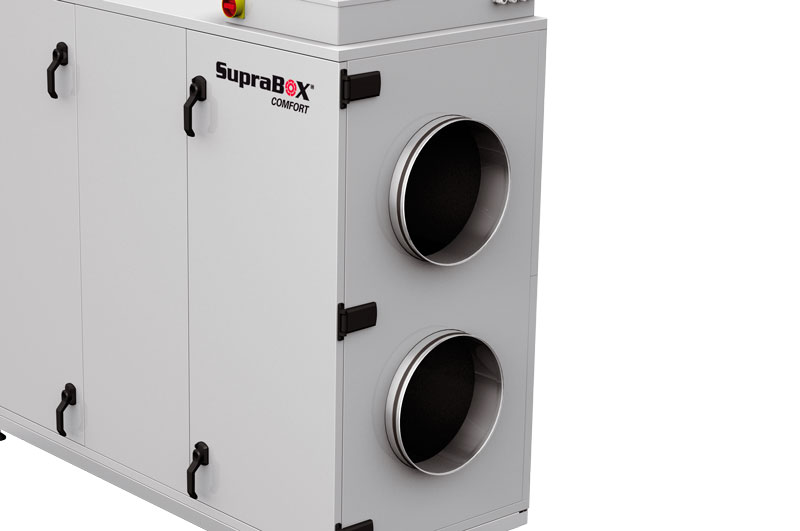
Rosenberg Suprabox Comfort Horizontal heat recovery unit has a small footprint and is highly efficient. This family offers horizontal connections and is available in 6 different sizes with airflows from 800 to 5000 m³/h. Models with waterproof protection are also available.
The Suprabox Comfort Vertical model differs in that this range has vertical connections and is available in 4 different sizes offering airflow ranges from 800 to 2000 m³/h.
Supabrox Comfort Ceiling is specifically designed for false ceiling installation due to its compact size. The product is available in two sizes providing an airflow of 1100 to 1900 m³/h.
The Suprabox Deluxe model is also available, designed for use in classrooms and training rooms, as well as offices and other communal spaces.
With integrated air discharge and direct exhaust air extraction through the unit, there is no need for additional ventilation pipes to the room direction.
A control based on CO₂ requirement ensures maximum comfort and creates optimum indoor air quality. There is a range of 2 sizes available with different ventilation system capacities depending on room occupancy and number of people.
In all available models, and depending on the room conditions, you can choose between units with left or right connections, in order to adapt to the existing system.