We explain ErP2026 and how the new fan efficiency regulations work
On July 24, EU Regulation 2024/1834 apply, amending the minimum efficiency requirements, labeling, and availability of spare parts for fans between 125W and 500kW.
This regulation repeals EU Regulation 2011/327 (ErP 2013 and 2015). It is part of the European Union's efforts to reduce energy consumption and polluting emissions from industrial equipment.
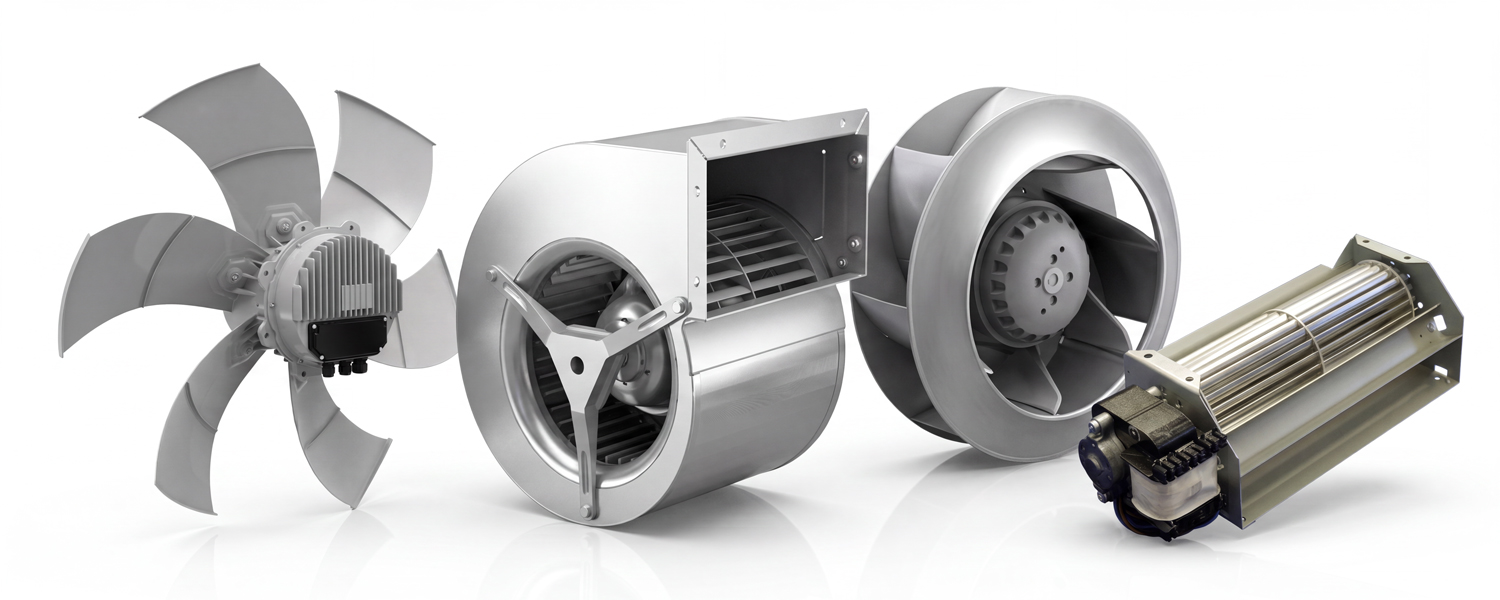
ErP2026 applies to fans placed on the market from 24th july 2026
How does the new ErP 2026 affect you?
If the fan has already been installed (before July 24, 2026), including those integrated into any equipment such as AHUs, ventilation boxes, etc., it does not need to be replaced.
Fans integrated into equipment that was already on the market before July 24, 2026, can continue to be sold and used until July 24, 2027, according to the previous standards, giving manufacturers and buyers time to test, specify, and design new models to replace non-compliant ones.
After that date, if a compliant replacement for your specific installation does not exist, a non-compliant "legacy spare part" replacement fan may continue to be supplied for repairs until July 24, 2037.
Does it comply with the regulation?
In case of doubt as to whether the purchased fans comply with the regulations, it can be checked by following the guidelines below.
| Question | ErP 2026 Applies | Exempt / Does not apply |
|---|---|---|
| Is the power between 125 W and 500 kW at its Best Efficiency Point? | Yes | No |
| Does the fan belong to an exempt category (detailed in the next point)? | No | Yes |
| Is it a standalone fan? | Yes (from 07/24/2026) | No, if it was already integrated into equipment placed on the market before 07/24/2026 (transition until 07/24/2027) |
Some fans and applications are exempt from compliance: motor cooling impellers, fans for hazardous areas, fans for toxic or corrosive gases, and air circulation fans.
FANS NOT INCLUDED IN THE REGULATION (EXEMPT)
The directive excludes the following specific types of fans and applications, so they fall completely outside its scope.
It is important to note that a fan designed for an exempt application or environment is not exempt if used in a different environment. For example, a smoke extraction fan used in a clean air application.
- By product type
- Impellers mounted exclusively to cool the motor they are attached to.
- Fans in washing machines/dryers with a nominal power of 3 kW or less.
- Kitchen extractor hood fans with a power of less than 280 W.
- Fans with an optimum efficiency point of 8,000 rpm or higher.
- Jet fans with a power of less than 750 W.
- Handling of hazardous or regulated gases
- Toxic, highly corrosive, or flammable gases or vapors.
- Explosive atmospheres (ATEX).
- Substances with biological risk (risk groups 2, 3, and 4).
- Carcinogenic or mutagenic substances.
- Gases with a compressibility factor other than 1.00 in the specified pressure/temperature range.
- Extreme operating conditions
- Gas temperatures above 100 °C or below −40 °C.
- Motor ambient temperatures above 60 °C or below −30 °C.
- Supply voltage higher than 1,000 V AC or 1,500 V DC.
- Transport of abrasive materials, solid particle concentration above 10 mg/m³, particle size of 0.1 mm or larger, Mohs hardness equal to or greater than 2, and average blade angle between 50° and 90° (all four conditions must be met simultaneously).
- Critical infrastructures and mobile equipment
- Fire emergency service (300 °C or more, capable of short-term operation for one hour or more).
- Nuclear installations.
- Military installations and civil defense shelters.
- Wireless or battery-powered equipment.
- Portable equipment whose weight is hand-held during use.
- Mobile equipment manually guided and moved while in operation.
- Air circulation fans.
Key dates
| July 24, 2026 Entry into force of the ErP 2026 Regulation | The new minimum efficiency requirements for fans from 125 W to 500 kW begin to apply, as well as the new obligations regarding product information and spare parts availability for fans placed on the market from this date. |
| July 24, 2027 End of the transitional period | The transitional period provided for fans integrated into equipment placed on the market before July 24, 2026, under Regulation (EU) No 327/2011, ends. From this date, part-load performance curves (minimum three speed points) on technical data sheets also become mandatory. |
| July 24, 2037 End of spare parts supply | Last date on which non-compliant replacement fans (spare part fans) intended to replace fans legally placed on the market before July 24, 2026, can be supplied. |
CHANGES IN THE ERP 2026 REGULATION
- Evaluation of the complete fan: efficiency is calculated on the motor + rotor + stator assembly, and not on individual components.
- New CE marking responsibility: if the buyer acquires an incomplete fan or modifies any of its components, they assume responsibility for CE marking compliance and the assembly's efficiency.
- More technical information: documentation requirements are expanded: more comprehensive data sheets, new part-load performance data, detailed labeling, and retention of information for 20 years.
- Stricter efficiency requirements: minimum efficiency is determined based on the fan type and its power, evaluating the assembly's real performance.
- End-of-life-oriented design: fans must facilitate disassembly, material recovery, and recycling using conventional tools.
- Greater availability of spare parts: spare parts supply obligations are expanded to guarantee repair and extend the equipment's lifespan.
FAQs
Do I have to replace existing fans?
No. The regulation only affects fans that enter the market after it comes into force.
Does Airtècnics comply with the new ErP?
Yes. At Airtècnics, we have been working with our suppliers for some time to adapt all our products and designs to the new ErP 2026 regulation, thus meeting market demands and continuously improving our product.
Who is legally responsible for compliance? Airtècnics, the fan manufacturer, or the OEM component supplier?
Whoever manufactured the finished complete fan unit, as marketed, is responsible. If you have made modifications to the fan unit, such as replacing the stator or impeller compared to the configuration with which it originally obtained the CE marking, then you are the fan manufacturer and, therefore, responsible for its compliance.
This is a consolidated principle of EU product law, not a novelty introduced by this regulation.
However, since compliance is now evaluated on the fully assembled fan and not on individual components, modifying or reassembling components changes who assumes that responsibility more frequently.
Please contact your account manager or the technical team if you need further clarification on who the manufacturer is in your case.
Does this apply outside the EU?
This is an EU regulation, and its application outside the Union depends on local regulations, which may change over time. Contact a specialist to confirm the requirements in force in your market.