Retrofit with ECFanGrid in the tertiary sector: efficiency, redundancy and energy saving
The renovation of an Air Handling Unit (AHU) in tertiary sector buildings cannot be viewed as an expense, but rather as a strategic investment with measurable returns. In a context where energy efficiency marks the difference between a competitive installation and an obsolete one, updating the key components of a dual-flow AHU can result in energy savings exceeding 40% and virtually eliminate unplanned shutdowns.
In this article, we explain what a comprehensive AHU renovation entails, what technologies make it possible, and why system redundancy is the differentiating factor most valued today by installers and facility managers.
What is a dual-flow AHU and why renovate it?
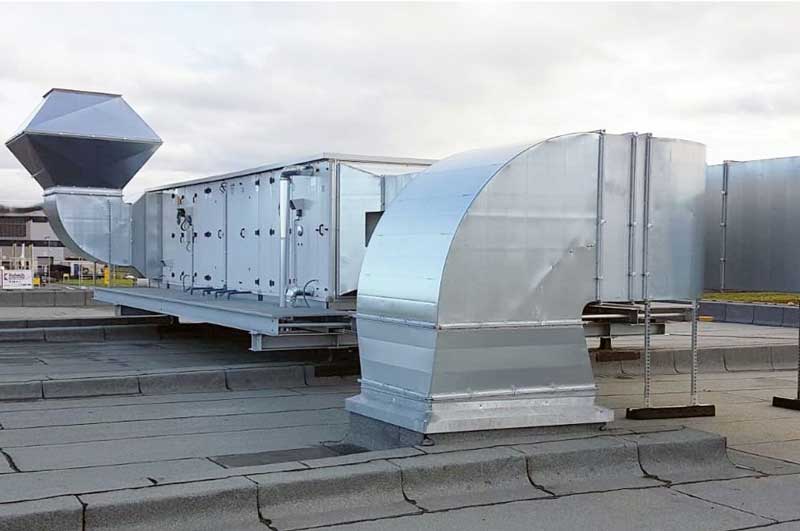
A dual-flow Air Handling Unit (AHU) is the centerpiece of the ventilation system in tertiary use buildings: offices, shopping centers, hotels, hospitals, or highly demanding industrial facilities.
Its function is to simultaneously control the supply flow of fresh air and the extraction of stale air, recovering energy in the process through a heat exchanger.
Over time, the supply and return components age: belt-driven fans lose efficiency, bearings require maintenance, and any failure can shut down the entire installation.
The case study: AHU renovation with ECFanGrid
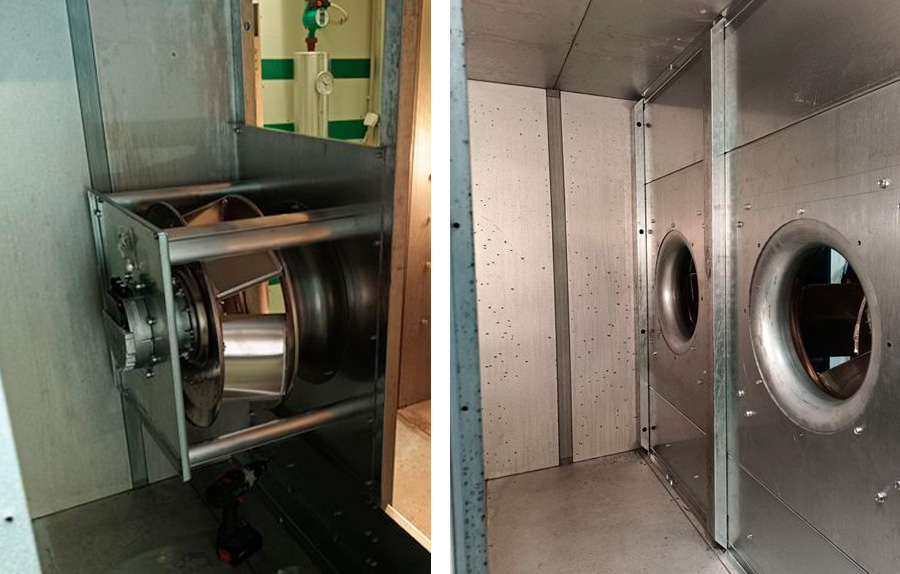
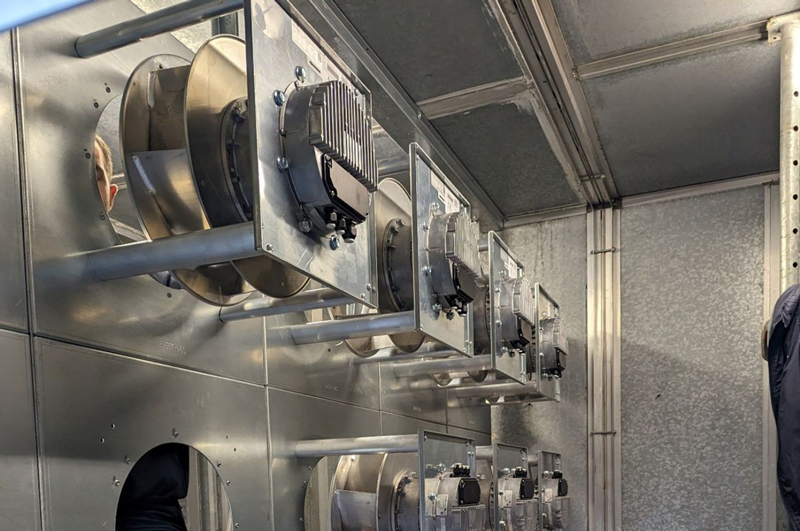
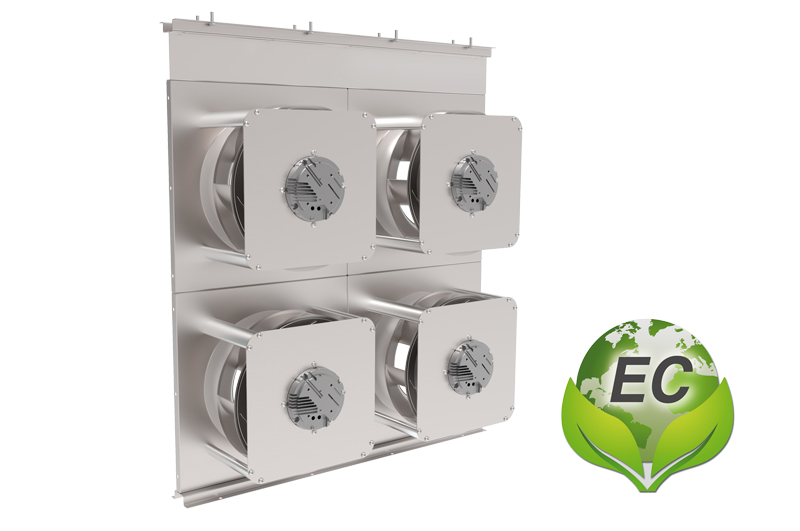
In a reference tertiary installation, our partners at Rosenberg France have carried out a complete renovation of the supply and return modules of a dual-flow AHU, replacing conventional technology with an ECFanGrid.
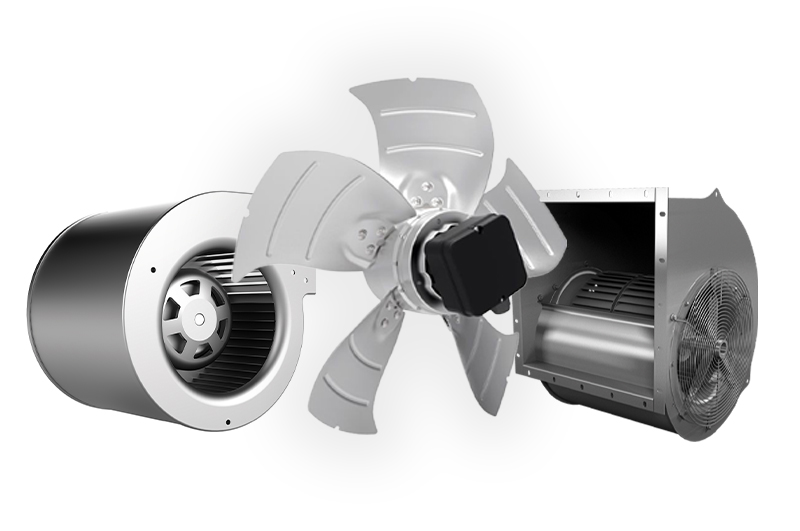
- 500 mm PlugFan ventilators
- AlMg3 aluminum impeller
- Capacity: ~19,000 m³/h
The system self-regulates in case of fan failure, ensuring service continuity.
Key benefits of the renovation
- Energy savings exceeding 40%: PlugFan ventilators eliminate transmission losses and maximize energy efficiency, significantly reducing electrical consumption.
- System redundancy: if one fan fails, the others automatically compensate, preventing unplanned shutdowns.
- Reduced maintenance, drastic reduction in operational costs
- No belts
- No pulleys
- No bearing lubrication
- Better air distribution: The fan wall generates uniform flow, improving the performance of filters, coils, and heat exchangers.
Comparative table: Conventional AHU vs. Fan Wall AHU
| Feature | Conventional AHU | Fan Wall AHU |
|---|---|---|
| Energy efficiency | Medium (IE1-IE3) | High (IE5) |
| Redundancy | No | Yes |
| Maintenance | High | Low |
| Shutdowns | Frequent | Almost non-existent |
| Air distribution | Non-uniform | Uniform |
Conclusion
- AHU renovation reduces energy consumption by more than 40%
- Eliminates unplanned system shutdowns thanks to redundancy
- Drastically reduces maintenance costs
- Improves overall HVAC system performance
Do you have an AHU that needs renovation? Contact our specialists and receive a personalized proposal.
FAQs
When should an AHU be renovated?
- Increased energy consumption in the installation
- Maintenance becomes a growing expense
- Frequent breakdowns occur
- Equipment is more than 10-15 years old
- Need for energy certification arises
What is the AHU renovation process?
- Audit: analysis of the existing system
- Design: sizing of the fan wall
- Installation: module replacement
- Commissioning: airflow validation
- Optimization: consumption adjustment