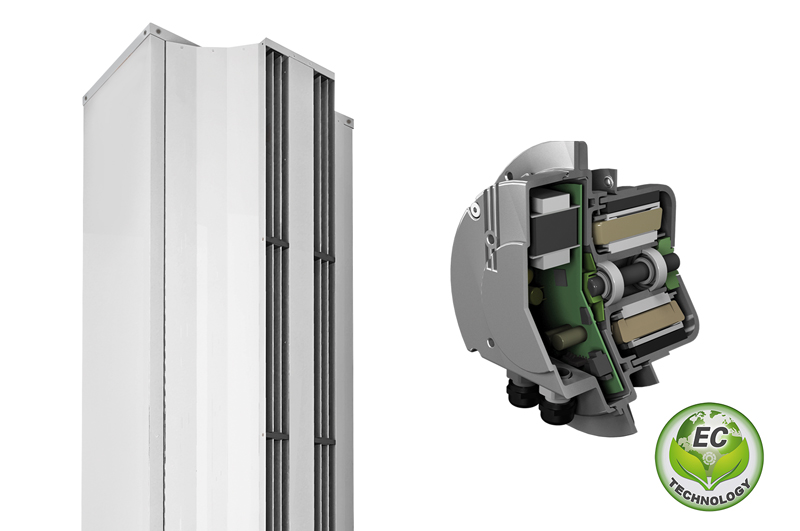
How EC Motors work and what are their advantages
How does an EC motor work? The EC (electronically commutated) motor is a synchronous motor powered by an inverter with permanent magnets in an external rotor design. The stator is driven by electronic switches controlled by a microcontroller. The motor needs to be supplied with AC voltage and a DC voltage signal to operate.
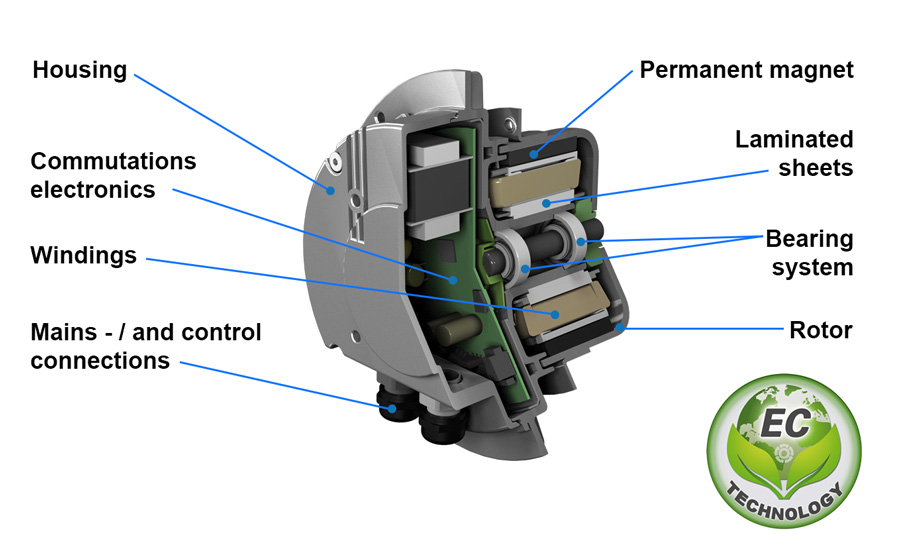
The mains voltage, namely the alternating current (AC), is rectified by the electronic commutation of the EC motor. A downstream inverter supplies the motor voltage via the direct current (DC) signal in accordance with the specified load. In contrast to the AC asynchronous motor, the EC motor is synchronous, which avoids slip losses and provides higher efficiency over a wider speed range.
Its speed depends on the DC voltage supplied to the motor via an inverter module, similar to the principle governing the frequency converter. However, the electronics of the motor differs in that it controls which phases of the stator it directs the current to depending on the position and direction of rotation.
EC motors control
By using intelligent electronics, the EC motor can take on a wide variety of control and regulation functions depending on the field of application
- infinitely variable fan speed control
- Pressure control
- Air volume flow control
- Motor temperature control
EC fans are fully compliant with the Energy Related Products Directive 2009/125/EG (ErP) that the European Union imposes regarding minimum energy efficiency requirements for energy consuming products.
EC technology offers more than just efficiency. EC motors don’t need maintenance and are low noise level. In addition, the integrated intelligent electronics take care of the control and monitoring of the correct operation of the motor. In this way, EC motors and fans meet the highest standards in terms of energy efficiency and sustainability.
Advantages of EC technology
- Very high efficiency
- Integrated control (continuous control)
- Very simple plug & play connection
- Additional functions via accessories (control of pressure, flow, speed, temperature, air quality, tachometer, alarms, etc.)
- Smaller motor size with performance equal to AC motors
- Energy and cost saving (lower energy costs, reduced energy bill)
- Applicable in all countries of the world