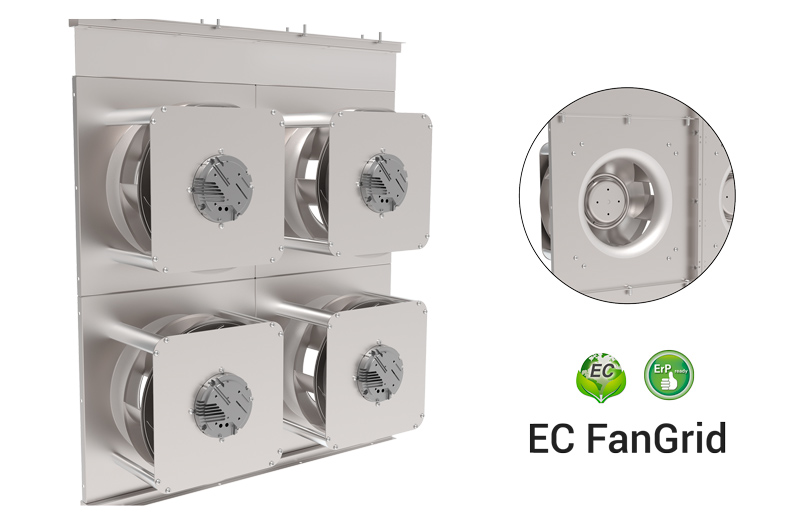
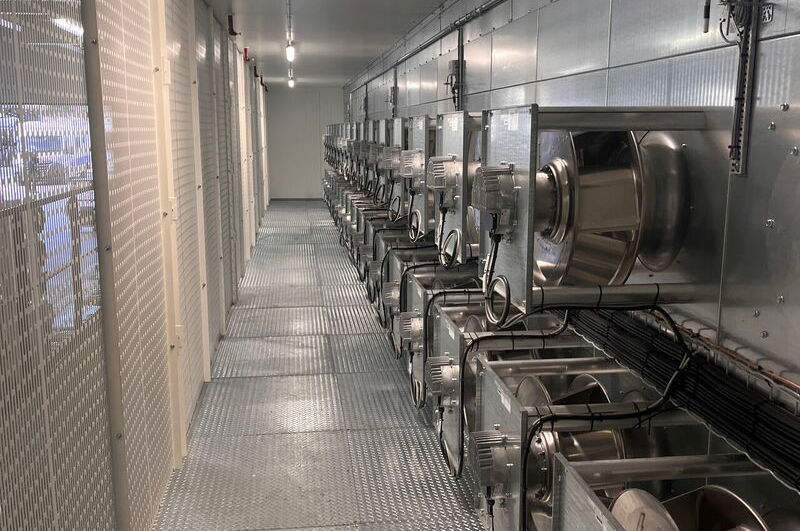
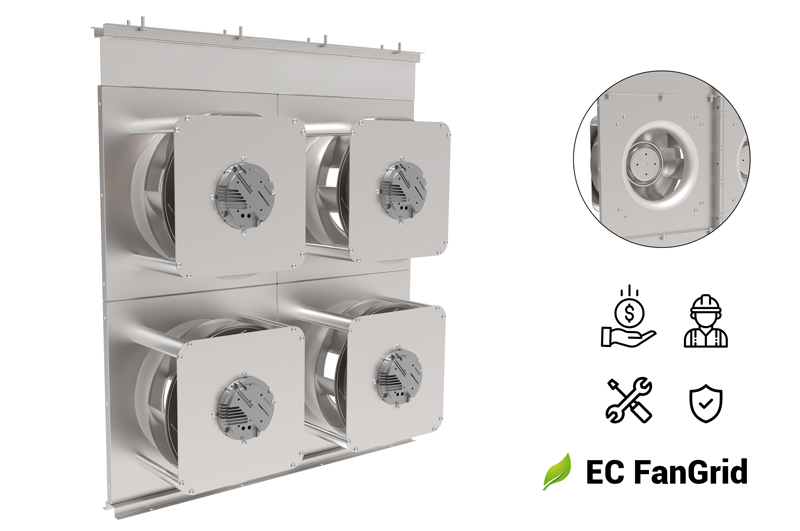
At Airtècnics, as specialists in ventilation solutions and air curtains, we address in this guide the types of fans, their technical characteristics and their real-world applications, with a practical approach oriented towards engineering and technical specification.
What is a fan and how does it work?
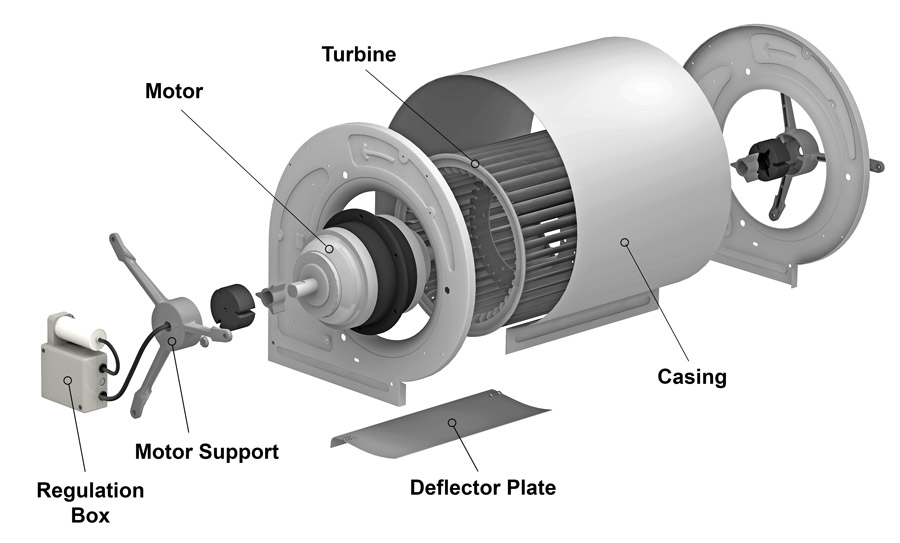
A fan is a set of motor and rotating blades that transfers mechanical energy to the air through an impeller, generating a controlled flow. This flow is used for ventilation, extraction, transport or cooling.
Key technical parameters
- Flow rate (Q): volume of air displaced (m³/h or m³/s)
- Static pressure (Pa): capacity to overcome resistance
- Absorbed power (W): energy consumption
- Efficiency (%): ratio between useful and consumed energy
According to the IDAE (Institute for Energy Diversification and Saving), the optimal operating point should be close to the maximum efficiency of the fan to minimise consumption and wear.1
Fan classification
| Fan type | Description | Technical specifications | Applications | Notes / Links |
|---|---|---|---|---|
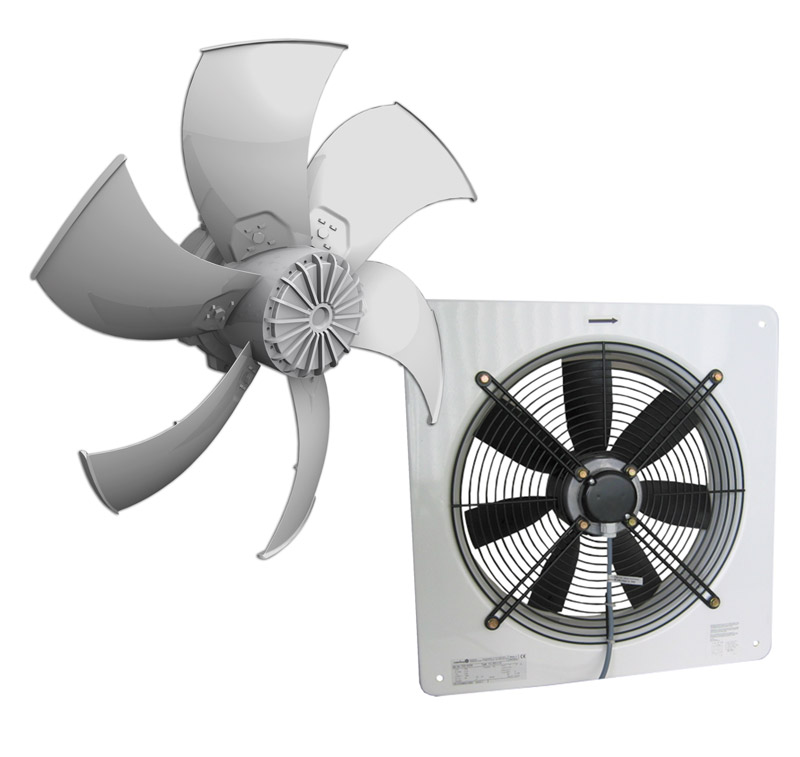
Axial
| Air flows parallel to the rotation axis. Most widely used in general ventilation. |
|
| See Airtècnics axial fans |
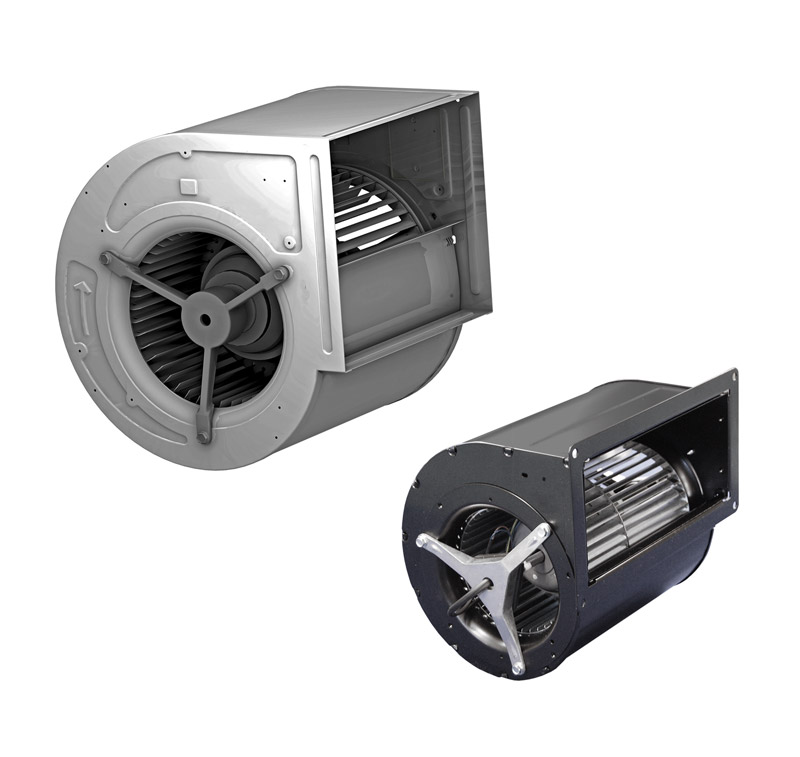
Centrifugal
| Air enters axially and is expelled radially, generating higher pressure. |
|
| See centrifugal fans |
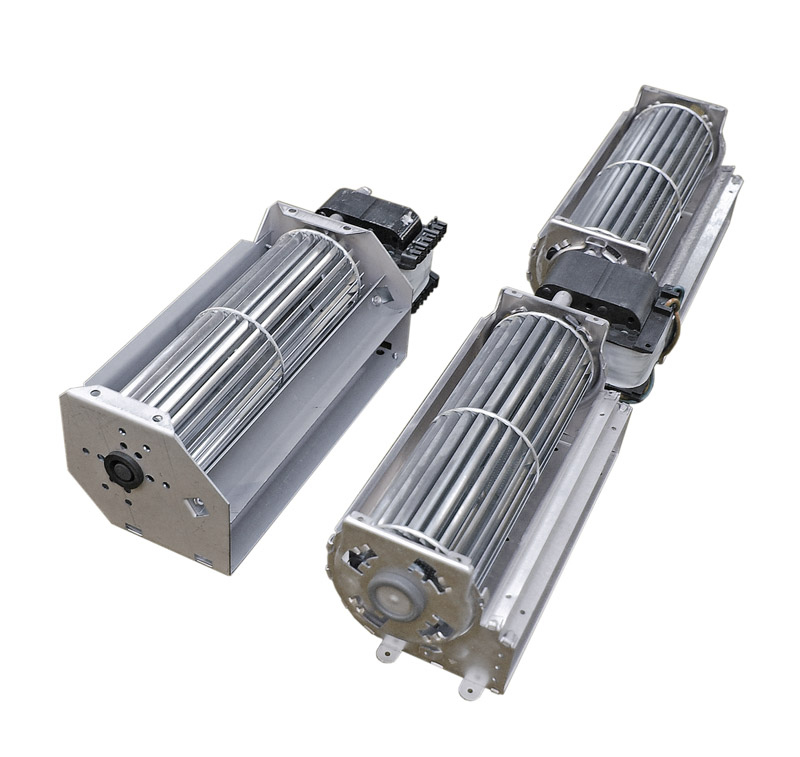
Tangential
| They generate a uniform airflow along their entire length. |
|
| See Airtècnics Cross-flow fan |
| Mixed flow | Intermediate solution between axial and centrifugal. |
|
|
1. According to air flow path
Axial fans
Air flows parallel to the rotation axis. They are the most commonly used in general ventilation. See Airtècnics axial fans
- High airflow rates: up to >200,000 m³/h
- Low pressure: typically < 500 Pa
- High efficiency in open applications
Applications:
- Industrial building ventilation
- Equipment cooling
- HVAC systems
Centrifugal fans
Air enters axially and is expelled radially, generating higher pressure.
- Pressure: up to >10,000 Pa
- Greater capacity for complex ductwork
- Better performance against pressure losses
Applications:
- Smoke extraction
- Industrial filtration
- Chemical processes
Tangential fans
They generate a uniform airflow along their entire length. They are used in some Airtècnics air curtain models, such as the Optima, the Aris or the TOP design air curtain.
Applications:
- Air curtains
- Compact HVAC equipment
Helico-centrifugal fans
An intermediate solution between axial and centrifugal.
- Medium pressure
- Compact design
- Installation versatility
2. According to impeller design
- Forward-curved blades: high airflow, lower efficiency
- Backward-curved blades: greater energy efficiency
- Radial blades: maximum robustness (dust, particles)
The choice of impeller directly affects energy consumption and the noise level of the system.
Conclusion
Choosing the right fan depends on striking the right balance between airflow, pressure and the specific application. In industrial and commercial settings, this decision has a direct impact on energy efficiency and the overall performance of the system.
In any case, the final selection of the fan must be made in accordance with the actual operating conditions of the installation, taking into account the required airflow, the system’s pressure drop and the permissible noise level.
At Airtècnics, we develop advanced ventilation solutions tailored to each project, combining innovation, efficiency and reliability.
Frequently asked questions (FAQ)
Which type of fan is best?
It depends on the application. Generally speaking, axial fans are used for high airflow at low pressure, and centrifugal fans for high pressure and controlled airflow.
How do you calculate the right fan?
Airflow, pressure losses and environmental conditions must all be analysed.
Which fan is most efficient?
Backward-curved fans with EC motors offer the highest efficiency. The PlugFan variant, manufactured in Germany by Rosenberg Ventilatoren, offers maximum efficiency.
The final energy efficiency will depend not only on the type of fan, but also on the motor, the control system and how well it is adapted to the specific ventilation system.