Efficiency against Human Respiratory Syncytial Virus (dry conditions) - Test result Laboratory of virus contaminants of water and food (University of Barcelona)
Wellisair: Efficiency against Human Respiratory Syncytial Virus (dry conditions)
Virus test report (nº 20191212-4): September 12th, 2019 Laboratory of virus contaminants of water and food from the University of Barcelona.
Scope: measure the effectiveness of Wellisair for the surface disinfection against Human Respiratory Syncytial Virus (RSV), the leading viral cause of acute lower respiratory tract infections: bronchiolitis and pneumonia, virus transmitted by faecal-oral route damaging the cells that line the small intestine, causing gastroenteritis.
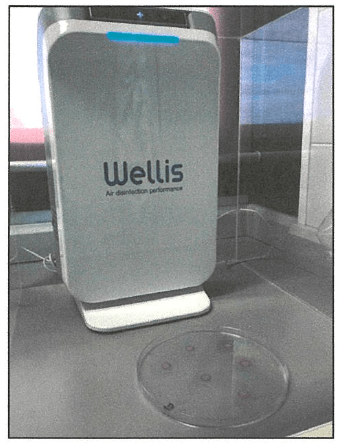
Procedure: Wellisair was located in a methacrylate box with one hundred microliter droplets over small pieces of glass, dried at room temperature.
At each testing time viruses were recovered in culture medium (MEM) and the viral particles were quantified by TCID50 in Hep2 cells.
Results:
RSV concentration decay under dry conditions | |||
Time | No treatment | Wellisair Treatment | |
Viruses (PFU/ml) | Viruses (PFU/ml) | Reduction (%) | |
0 min | 5,30x10⁴ | 5,30x10⁴ | - |
30 min | 5,00x10⁴ | 1,29x10⁴ | 74% |
1h | 4,30x10⁴ | 1,23x10⁴ | 87% |
2h | 4,71x10⁴ | 9,05x10³ | 92% |
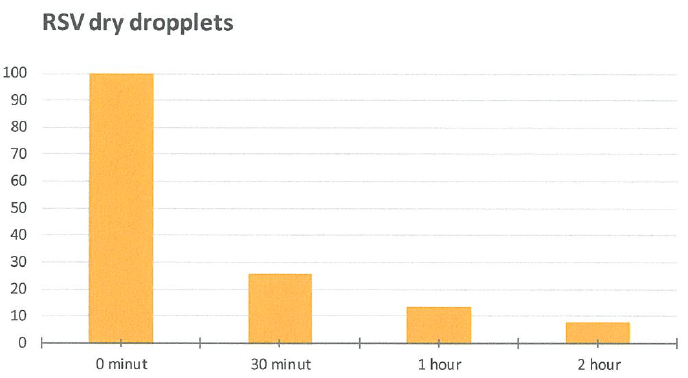
Conclusions: Wellisair air disinfection was able to reduce 92% of the initial concentration of RSV after 2 hours of treatment. The Wellisair efficiency on aerosols receiving equivalent doses could be expected to be at least equivalent.